Saturday, 2 March 2013

The Philosophical Gamer: Deus Ex - Human Revolution


Foreword:
This is the first in what I hope will be a series of posts on philosophical themes in the video game industry. This will be of most use to Philosophy of Media and Philosophy and Everyday Life students, but it's aimed at everyone and will hopefully provoke some interesting debate!

Enjoy :)
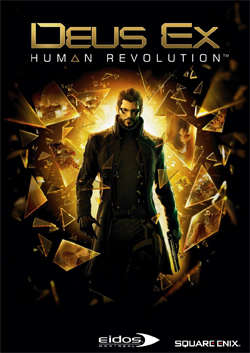
 
 
TL;DR: (too long, didnt read) Deus Ex's major themes are transhumanism, existentialism, artificial intelligence, and capitalism. Try it!

Prequel to the original and critically aclaimed Deus Ex, "Human Revolution" delves further into philosophical themes largely skimmed over in the first game, namely Transhumanism. But first, lets get some context.

The Setting

Whereas the orignal was set in a more "far future" setting where every man and his dog has whimsical cybernetic gizmos coming out of their ears, Human Revolution is a much more "near future" experience, set years before when cybernetic "augmentations" are just beginning to make an impact on society.

You step into the shoes of Adam Jensen, cop turned corporate security chief, and due to a rebuilt-after-accident gimmick, (something totally not exploited in modern storytelling) the most augmented human on the planet. You also have a unique immunity to the side-effects of augments, i.e. the human body not being ok with bits of metal jammed in it, thus he doesnt need to take the medication to avoid this, but this will be explored later. Jensen is hired on to the security wing of a leading cybernetics company when stereotypical shadowy military types storm the building, kidnap the love interest alongside box-of-top-secret-whatnot, and render Jensen crippled and on the brink of death. His boss, taking a page from the Umbrella Corporation School of Human Resources takes the opportunity to cram Jensen with more cybernetic gadgetry than the space shutte. Voila! One gritty superhuman with a chequered past and an axe to grind.

Now referred to as the next stage in evolution by his employers, and an unnatural bucket of bolts by his enemies, Jensen will wander a neo-renaissance Earth and see first hand the effects of the revolution of cybernetics and, as is customary, uncover a deep conspiracy and save the earth. Hurrah.

The Themes

- Transhumanism
At the core of DE-HR's story is the fundamental question of what it means to be human. Indeed, Jensen himself is quite literally "more machine than man", who among other things, can see through walls and is immune to toxins. But on top of that, while Jensen is superhuman by pure accident, many people in this world choose to replace their original body parts with new augmentations. Does replacing body parts with durable, reliable machinery make you inhumane, or unnatural?

On the one hand yes, it does. Humans are organic life which evolves, sustains itself, reproduces and dies. Intergrating something synthetic into that means that you can no longer really call yourself an organic lifeform. You're robbed of the need to evolve, you can live an unnaturally long life, perhaps even become quasi-immortal if machines replace vital organs. As a matter of fact, during this story you can hear a young couple lamenting over their choice to "augment". They can no longer feel each other when they hold hands. Just cold metal. At another point, you hear a woman tell of how she needs, not wants, needs to be augmented in order to keep her job as a stock broker, else she'll lose out to people who can afford the implants.

But on the other hand, if we are to call this unnatural then we must look back at the entirety of human history and ask a serious question; aren't we already unnatural beings? Right now, I'm not actually talking to you. I'm sitting at home in my PJ's, creating my message on a device created in a factory, which can access this profoundly unnatural realm of exitance, i.e. the internet. Those of us with short or long sight, use synthetic lenses to correct our vision. If we break our legs, we are given a crutch. Even when you read a book, you're utilising something unnatural to convey ideas that cant be expressed in the "natural" world. We already use technology to enhance our lives, so why is this such a big moral leap?

- Capitalism
More of an undercurrent in this story, or more the effects of hypercapitalism on the poor. It's one-sided but also makes a poignant observation. Cybernetics dont just magic themselves into existence. Someone has to make them, and nothing in this world is free. The rich can pay for the very best implants, as well as the medication to stop the body rejecting them. Those struggling to feed kids can afford no such luxury, thus creating an elite of wealthy near-superhumans, who are in some ways mentally and physically superior. The game exaggerates this, but it's not entirely unrealistic. Just look at education here, or healthcare in the United States.

- Some Theoretical Perspectives (very brief)
Marx would be apopleptic at the state of the world in DE-HR. Not only are the working class ruthlessly explioted by their corporate masters, but this obsession with augmentation, replacing human parts with machinery absolutely shatters the sense of authenticity in life.

Nietzsche would perhaps see this as the "Superman" coming to fruition. A new type of sentient being which is quite literally exempt from natural laws and protocals which govern "normal" humans. All hail our cybernetic overlords.


So, in summary, I hope you enjoyed reading and I hope that this will inspire you to see the philosophy all around us.

Now lets have some debate in the comments!

Thursday, 13 December 2012

Charles Peguy

I was stimulated to post something on Charles Peguy after hearing an interesting paper at a conference in Italy over the summer by Pete Candlor of Baylor University in Texas (some of the ideas posted here are derived from his paper). Peguy is interesting because he offers a critique of modernity that is both Christian and Socialist in equal measure. Peguy was writing at the turn of the last century and like Nietzsche his is one of the chief prophets of our age. According to Peguy, modernity is radically against us as human beings as it has handed us over to nihilism without recompense. The modern world, in his view, is radically anti-human and it is so because of its failure to synthesise the temporal and eternal in way that has rendered live liveable. In his view, only in relation to eternal is humanity capable of freedom and so modern freedom, that is based upon recognition of a necessary finitude, is essentially illusory. As he states, in modernity the monuments celebrate freedom but the modern world itself oozes slavery (an acute philosophical observation, if ever there was one). Of course, the idea that modernity has engendered a new form of slavery was integral to Marx's critique of contemporary capitalism - but Peguy digs deeper than Marx and examines the ontological basis of modern servitude. For Peguy, this servitude is the result of mistaken conception of humanity, one the fails to grasp the humanity is most fully human only in relation to the eternal and the infinite. Peguy prefigures much contemporary critical thought (that is currently attempting to reinstitute the infinite as a basis for social critique). He also explores ideas in a philosophical poetics, a much neglected literary form for conveying philosophical issues. Neil Turnbull

Friday, 30 November 2012

Marcuse and Art

I have just been reflecting a little on Marcuse's aesthetics in his book The Aesthetic Dimension . According to Marcuse, in modernity art has been institutionalised in a way that legitimates a particular kind of 'disinterested' comtemplative attitude towards the world. As such, art possesses a certain kind of autonomy from society and politics athat allows it to stand as their critic. More specifically, art, in Marcuse's view, has the power to negate society as it currently exists by offering a kind of escape from an oppressive society into oneself and one's own experience. I was wondering whether anyone might provide specific examples of art works that have provided just this function for them, a kind of interior escape into another world, a world that this one might in fact one day become? Neil

Thursday, 29 November 2012

Fashion and Materiality

Last night, we welcomed Prof Tom Fisher from the School of Art and Design who spoke to us on the topic of 'fashion and materiality'. Tom argued that in conceptual terms that fashion is essentially a contradictory phenomenon - being both individualistic yet conformist, democratic yet elitist and highly particular yet completely universal. He went on to examine the philosophical aspects of a number of sociological theories of fashion and explored why fashion seems to be an essential characteristic of modernity through its propagation of the idea of taste-cultures and individual lifestyles. Fashion, he suggested, signifies the radically contingent aspects of the modern, its sense of possibility as a series 'of things that could just as well be otherwise'. Fashion seems to be essential to much of human life today and philosophers have had very little to say about it - the most important thinkers in this regard being social theorists (especially, as Tom reminded us, the 20th century German social theorist Simmel). Plato was famously anti-fashion (more interested, like most Greek philosophers, in the eternal and immutable). Is fashion open to philosophical reflection or must the philosopher be 'anti-fashion'? Neil T

Thursday, 9 February 2012

Occupy

I thought it would be interesting to start a discussion on the Occupy protests that have currently made themselves so prevalant. What is your view on the movement? Is capitalism the lesser of all the evils? What do you think Karl Marx would have to say about this -- and is it simply just a cry out for communism?

---

Ever since the Occupy protests started on September the 17th of last year, the movement has grown exponentially. There are well over 2000 occupy groups, spanning over around 80 countries. The first widely known occupy protest was held in New York, by a group going by the name of 'Occupy Wall Street.'

You may have heard of the Occupy protests, seen them on the news -- but what is it really all about?

The movement is innately anti-capitalist. The slogan "we are the 99%" is in reference to the top one percent of earners owning most of the wealth-- and therefore holding the most power. We can see this in effect quite vividly in America, where the top 1% of earners own around 35% of the country's wealth and the top 20% own, staggeringly, around 80% of the country's wealth.

The goal of the movement is to, in general, empower the lower classes by redistributing the world's wealth. Even a small fraction of the earnings of the top 1% would be enough to help a lot of services and a lot of people. People from the movement believe that it is unfair or even unjust that the balance of wealth is so skewed. Therefore, the movement is very much in favour of ideas such as The Robin Hood Tax.

Read More
The Occupy Movement on Wikipedia
The Robin Hood Tax


The Occupy Nottingham Camp Site


Nottingham has its own Occupy protest camp, which has been there for some time. The camp is currently situated in the Old Market Square near the fountains. They have even set up an information tent where you can drop in and ask them questions.

Occupy Nottingham
Occupy Nottingham on Facebook

Tuesday, 7 February 2012

Philosophy - Red Week Events

Philosophy – Red Week Activities

Tues 14th
Philosophy Drop in Session (all years) 11-1pm in room 215 – with Ruth Griffin
Come along to this informal student led drop-in session where we can discuss anything relating to Philosophy at NTU. This is your chance to seek guidance about assignments or class tests, discuss your dissertation, debate topics of Philosophical interest, or simply revisit areas which you are unsure of - or would like to pursue further - within a friendly and informal environment. All years welcome.

Weds 15th
12-3pm in room 215 - MA Research Presentations – Open Discussion – With Patrick O’Connor and the MA Students
The MA in Philosophy students of Nottingham Trent University will present a showcase of their current research and studies.
Presenting short 20 minute papers Jim Bunker, Verity James, Zak Miller, and John Bregan will present short talks on the
value of egoism, the philosophy of film, Leibniz and Newton on time and space, and philosophy and the recent riots. This will present an exciting opportunity for undergraduates to see what it takes to be a philosophy postgrad, and maybe even give them the opportunity
to test their mettle against their more ‘senior’ postgraduate colleagues!!!


Friday 17th 11-1.30 pm in 215 – Screening – ‘Tree of Life’ - With Neil Turnbull


This is an important film in philosophical terms – possibly the most explicitly metaphysical film made in recent years. It explores ideas of nature and creation in relation to ethical issues and especially the relationship between nature, love and loss. It is quite mind-blowing at times. Please try to get along to this and join in the discussion afterwards.
Here is a recent review of the film by Peter Bradshaw in The Guardian (see http://www.guardian.co.uk/film/2011/may/16/cannes-2011-the-tree-of-life-review)


Terrence Malick's mad and magnificent film descends slowly, like some sort of prototypical spaceship: it's a cosmic-interior epic of vainglorious proportions, a rebuke to realism, a disavowal of irony and comedy, a meditation on memory, and a gasp of horror and awe at the mysterious inevitability of loving, and losing those we love.
Sean Penn has a central but minor role as Jack, a careworn 21st-century corporate executive who is now disenchanted with his life. At the moment of crisis, he is carried back to an ecstatically remembered 1950s boyhood in smalltown America. He remembers his relationship with his demanding, disciplinarian father, played by Brad Pitt, and the brother who died at the age of 19: the news is brought to his distraught mother (Jessica Chastain) via an official communication – the telegraph delivery boy thrusts it into her hands and walks quickly away – so he appears to have died on military service.
Jack realises that time, far from healing the wounds of loss, only makes them more painful. Along with the dream-lit tableaux from his childhood, he is vouchsafed extraordinary visions of geological time and the unknowable reaches of the universe, in comparison with which his loss is meaningless. And yet meaning has to be found if the pain is not to be unendurable. In a sense, the purpose of these gigantic visions is to anaesthetise the pain of being alive and not understanding.
Brad Pitt dominates the bulk of the film as Mr O'Brien, who appears on the face of it to be a God-fearing family man with a button-down shirt and crewcut, brusquely but sincerely in harmony with his gentle, beautiful and profoundly religious wife. Chastain has a voiceover at the very beginning asking her sons to prefer God's grace to the beauties of nature, as the truer path. But O'Brien is far more complex than first appears: he is angry with his boys; he respects the severity of traditional churchgoing belief, but aspires to riches and worldliness, taking out patents in the aeronautics industry and dissipating the family's means in the process.
He challenges his boys to hit him, to toughen them up, and does not hesitate to hit them for disobedience and discourtesy. He plays the organ in church and is a disappointed musician; his frustration and rage simmer from every pore. His boys feel fear as well as love: Malick shows how they have fused into the same emotion. They are encouraged to respect his violence and secretly to feel contempt for their mother's gentleness, and yet their fascinated alienation expresses itself in one startling scene involving an incursion into the parental bedroom.
And there are the baffling and bizarre symphonic passages of non-narrative spectacle, prehistoric jungles, arid deserts, galaxies and spiral shapes – Kubrickian landscapes of wonder. Weirdest of all is the engorged river in which a wounded dinosaur lies prostrate; another dinosaur comes along, plants its great foot on the other's neck and then moves heedlessly on. Is this the only message of the universe – pure survival? But then how is it we want something other than survival? What do we want to survive for? And Malick appears, through sheer crazy excess, to bring his movie closer to the ultimate question: why does anything exist at all?
This film is not for everyone, and I will admit I am agnostic about the final sequence, which suggests a closure and a redemption nothing else in the film has prepared us for. But this is visionary cinema on an unashamedly huge scale: cinema that's thinking big. Malick makes an awful lot of other film-makers look timid and negligible by comparison.

NT/RG/POC – Feb 2012

Wednesday, 14 December 2011

Zizek?

I thought that it might be a good idea to get a debate going about the overall philosophical/intellectual significance of the ideas of the media-savvy Slovenian philosopher Slavoj Zizek.

I have been spurred on to do this because some academics whose opinion I respect have told me in conversation that they think Zizek is essentially an opportunist and a charlatan who when you examine his texts in a serious and sober way has very little to say.

I wonder what people's opinion might be regarding this claim? I am minded to disagree, but I am not sure why exactly. On relfection, although I really enjoy reading Zizek I am not sure that I have grasped anything that can be termed a coherent intellectual position. There is clearly an anti-postmodern commitment to universalism in his work - but this is pretty thin beer and nothing that we could term 'distinctive'. There is of course also the Lacanian stuff about enjoyment and the contemporary super-egoic compulsion to enjoy - but again this doesn't really provide the basis for a substantial philosophical position. Perhaps this isn't the point. Perhaps Zizek is really like a modernist artwork, designed to shock (and in this way he is perhaps close to Nietzsche).

Maybe someone could enlighten me and spell out exactly, in nuce, what Zizek's intellectual position might be?

Neil T